
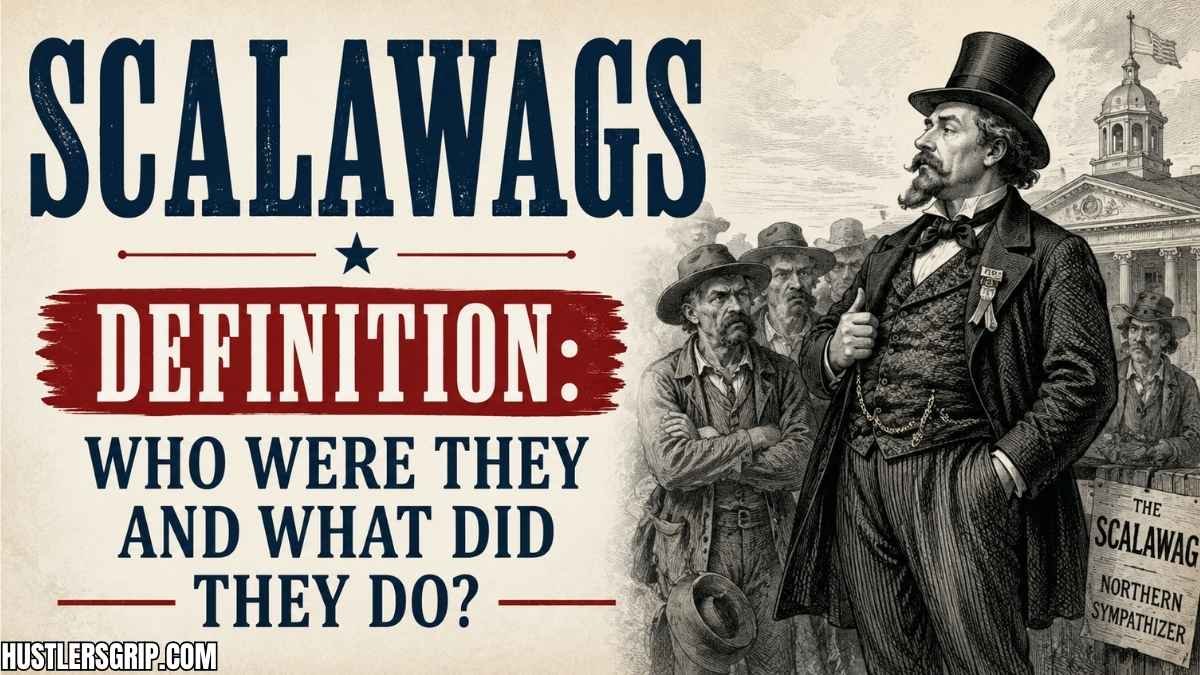
Scalawags Definition: Who Were They and What Did They Do?
Introduction
Have you ever heard someone called a “scalawag” and wondered what it really means? Today, the word might sound like a playful insult for a mischievous person. But during one of the most turbulent times in American history, the scalawags definition carried much heavier weight. It referred to white Southerners who made a choice that shocked their neighbors and changed the course of the nation.
The scalawags definition in U.S. history points to white Southerners who supported Reconstruction and the Republican Party after the Civil War. These were people born and raised in the South who decided to break away from their fellow Southerners. They joined forces with freed African Americans and Northern newcomers called carpetbaggers. Their actions made them heroes to some and traitors to others. Understanding who they were helps us understand a critical turning point in American history.
Featured Snippet Definition
What is the definition of scalawags?
A scalawag was a white Southerner who supported the federal government’s Reconstruction policies after the Civil War and joined the Republican Party. The term was used as an insult by those who opposed Reconstruction. Scalawags worked alongside freed African Americans and Northern carpetbaggers to reshape Southern politics and society.
What Exactly Is a Scalawag?
To put it simply, a scalawag was a white person from the South who supported Reconstruction after the Civil War. Reconstruction was the period from 1865 to 1877 when the United States tried to rebuild the South and give rights to formerly enslaved people.
Scalawags were Southerners who chose to side with the Republican Party. At that time, the Republican Party was the party of Abraham Lincoln and the Union. It was also the party that pushed for equal rights for African Americans.
Many people in the South saw scalawags as traitors. They believed these Southerners had turned their backs on their own people. The word “scalawag” was used as a slur to shame and insult them.
But not everyone saw scalawags that way. To the federal government and African Americans seeking freedom and equality, scalawags were allies. They helped build new state governments and supported policies that gave Black citizens the right to vote and hold office.
The Origin of the Word “Scalawag”
Where did the word “scalawag” come from? The truth is, historians aren’t completely sure. But we do know some interesting facts about its history.
From Farm Animals to Insults
The word first appeared around 1848. Back then, it meant a disreputable or worthless person—someone you couldn’t trust. Some experts think it might have originally been used to describe low-quality farm animals.
One theory connects the word to Scalloway, a village in Scotland. According to this idea, the name became linked with scraggly, inferior livestock.
A Dictionary Definition
In 1860, Worcester’s Dictionary defined scalawag as “A low worthless fellow; a scapegrace”. A “scapegrace” is another old-fashioned word for a rascal or troublemaker.
The Political Meaning Emerges
During Reconstruction, Southern newspapers that opposed the Republican Party started using “scalawag” to describe white Southerners who supported Reconstruction. The insult stuck. It became a powerful tool to shame and isolate these Southern Republicans.
Today, historians still use the term. But they use it without the insulting meaning. It has become a neutral way to describe a specific group of people from that time period.
Who Were the Scalawags?
Scalawags came from all walks of life. They weren’t just one type of person. Let’s break down who they were.
Small Farmers
The largest group of scalawags were non-slaveholding small farmers. These were people who worked their own land and didn’t own enslaved people. Many of them had always resented the wealthy plantation owners who controlled Southern society.
Business Owners and Professionals
Scalawags also included merchants, artisans, and other professionals. These were store owners, craftspeople, and people with specialized skills. They saw benefits in rebuilding the South with new businesses and industries.
Former Union Supporters
Many scalawags had remained loyal to the Union during the Civil War. Some had even served in the Union Army or been imprisoned for their Union sympathies. After the war, it made sense for them to support the party that had won.
Former Confederates
Surprisingly, some scalawags had actually supported the Confederacy during the war. After the war, they changed their minds. Some did it because they believed in the new direction. Others did it for more practical reasons.
Plantation Owners and Aristocrats
A smaller number of scalawags came from the planter class—the wealthy families who had owned large plantations and many enslaved people. These individuals broke ranks with their own social class to support Reconstruction.
How Many Scalawags Were There?
Historians estimate that scalawags made up about 20 percent of the white electorate in the South during Reconstruction. That’s a significant number. In some states, they made up an even larger percentage of Republican voters.
Why Did Southern Whites Become Scalawags?
People became scalawags for many different reasons. Some were idealistic. Others were practical. Let’s explore the main motivations.
Resentment Toward the Planter Class
Many small farmers had long resented the wealthy plantation owners. Before the Civil War, the planter class controlled Southern politics and society. Small farmers often felt looked down upon. Reconstruction offered a chance to shift power away from the old elite.
Desire for Modernization
Some scalawags wanted to modernize the South. They wanted factories, railroads, and businesses. They believed that working with the federal government and the Republican Party would bring progress to their region.
Belief in Equality
Some scalawags genuinely believed in equal rights for African Americans. These were people who had come to see slavery as wrong and wanted to build a more just society.
Practical Self-Interest
Others supported Reconstruction for personal gain. They saw opportunities in the new political order. They could get government jobs, contracts, or other benefits by supporting the winning side.
Union Loyalty
For those who had supported the Union during the war, joining the Republican Party was a natural continuation of their beliefs. They had always been on the side of the federal government.
Fear and Survival
In some cases, people became scalawags simply to survive. The federal government controlled the South during Reconstruction. Supporting the government could mean protection and opportunity. Opposing it could mean trouble.
Scalawags vs. Carpetbaggers: What’s the Difference?
People often confuse scalawags and carpetbaggers. They were both groups that supported Reconstruction and the Republican Party. But they were different in one important way.
| Feature | Scalawags | Carpetbaggers |
|---|---|---|
| Where they came from | Born and raised in the South | Originally from the North |
| Why they were in the South | They already lived there | They moved South after the Civil War |
| How Southerners saw them | Traitors to their own region | Outsiders trying to exploit the South |
| What they brought | Their existing homes and lives | A carpetbag (a type of suitcase) |
The Key Difference
The main difference is where they came from. Scalawags were native Southerners. Carpetbaggers were Northerners who moved South.
Why the Names?
- Scalawag was an insult for a Southern “traitor.”
- Carpetbagger came from the carpetbags that many Northerners carried when they traveled South.
Did They Work Together?
Yes! Scalawags, carpetbaggers, and freed African Americans formed a coalition that controlled Southern state governments during Reconstruction. Together, they were able to pass new laws and create new state constitutions.
The Role of Scalawags in Reconstruction
Scalawags played a crucial role in Reconstruction. Without them, the Republican Party would not have been able to govern the South.
Building New Governments
After the Civil War, the Southern states had to create new governments. Scalawags helped write new state constitutions. These constitutions gave voting rights to African American men and created public schools for the first time.
Passing New Laws
Scalawags in state legislatures passed laws that:
- Protected the rights of freed African Americans
- Created public schools for both Black and white children
- Made taxes more fair
- Helped workers get better treatment
Holding Office
Many scalawags held political office. They served as:
A Significant Force
Scalawags weren’t a small fringe group. They made up about one-fifth of the electorate. That was enough to make a real difference in elections.
Their Coalition
The Republican coalition in the South had three parts:
- Freed African Americans – the largest group of voters
- Scalawags – native white Southern Republicans
- Carpetbaggers – Northerners who had moved South
Together, these groups controlled Southern state governments for about a decade.
Famous Scalawags in History
Several well-known figures from American history were scalawags. Let’s meet a few of them.
General James Longstreet
James Longstreet was one of Robert E. Lee’s top generals. After the war, he supported Reconstruction and the Republican Party. He even led Black militia troops to fight against white supremacist violence. Many Southerners never forgave him for this.
Joseph E. Brown
Joseph E. Brown had been the wartime governor of Georgia during the Civil War. After the war, he became a Republican and supported Reconstruction. He later served as a U.S. senator.
James L. Alcorn
James L. Alcorn of Mississippi was elected to the U.S. Senate during Reconstruction. He was one of the most prominent scalawags in the country.
Franklin Moses Jr.
Franklin Moses Jr. of South Carolina took an unusual path. He had supported secession and served in the Confederate army. But as Reconstruction governor of South Carolina, he championed racial equality and socialized freely with former enslaved people. His old friends denounced him.
Charles Hays
Charles Hays of Alabama was a former slaveholder and Confederate soldier. He shocked his fellow Southerners by embracing the Republican Party and supporting the rights of freedmen.
Richard Whiteley
Richard Whiteley was a scalawag in Georgia. He worked as a lawyer for the Freedmen’s Bureau, helping formerly enslaved people protect their rights.
These men came from very different backgrounds. But they all made the same choice: to support Reconstruction and work with African Americans and Northerners to build a new South.
Why Were Scalawags Hated So Much?
Scalawags faced intense hatred from other white Southerners. In some ways, they were hated even more than carpetbaggers.
Seen as Traitors
To many white Southerners, scalawags were traitors to their race and region. Carpetbaggers were outsiders. But scalawags were “one of us” who had turned against “us.” That felt like a deeper betrayal.
Threat to White Supremacy
Scalawags supported equal rights for African Americans. This directly threatened the system of white supremacy that had existed in the South for centuries.
Breaking Racial Solidarity
The Confederacy had been built on the idea of racial solidarity among white Southerners. Scalawags broke that solidarity. They worked with Black people as equals. To many white Southerners, this was unforgivable.
Political Opposition
Southern Democrats hated scalawags because they helped Republicans win elections. Without scalawags, the Republican Party would have had a much harder time controlling Southern state governments.
The Language of Hate
Newspapers that opposed Reconstruction used vicious language to describe scalawags. One Alabama editor called them “the local leper of the community”. They were described as “impure” and “ill-conditioned”. This hateful language encouraged violence against them.
The Ku Klux Klan and Violence Against Scalawags
Scalawags didn’t just face insults. They faced real physical danger.
Targets of Violence
The Ku Klux Klan and other white supremacist groups targeted scalawags for violence. They were attacked, threatened, and sometimes killed.
Why They Were Targeted
The Klan wanted to:
- Intimidate scalawags into leaving the Republican Party
- Stop them from voting or holding office
- Send a message to other white Southerners about what would happen if they supported Reconstruction
The Toll of Violence
The violence against scalawags was part of a larger campaign of terror. The Klan also attacked:
- African Americans who voted Republican
- Carpetbaggers
- Schools and churches for Black communities
Did It Work?
In many cases, yes. The violence and intimidation pushed some scalawags to leave the Republican Party. By the mid-1870s, many had switched sides or given up politics entirely.
The Decline of the Scalawags
Scalawags didn’t stay in power forever. Their influence declined over time.
The End of Reconstruction
Reconstruction officially ended in 1877. That year, the last federal troops were withdrawn from the South. Without federal protection, Republican governments in the South collapsed.
Switching Sides
As the Democratic Party regained power, many scalawags switched parties. They became Democrats again to survive politically and socially. Some had always been more interested in power than in principle.
The “Redeemers” Take Over
Southern Democrats called themselves “Redeemers”. They claimed they were “redeeming” the South from corrupt Reconstruction governments. By 1877, they had taken control of every Southern state.
A Lost Cause Mythology
After Reconstruction ended, Southern whites created a mythology about the era. In this version of history, Reconstruction was a terrible time of corruption and oppression. Scalawags and carpetbaggers were the villains.
This mythology lasted for generations. It shaped how Americans understood Reconstruction for nearly a century.
The Legacy of the Scalawags
What did scalawags leave behind? Their legacy is complicated but important.
Positive Contributions
Despite the hatred they faced, scalawags helped achieve real progress:
- They helped create the South’s first public school systems
- They supported voting rights for African American men
- They helped write new state constitutions that were more democratic
- They worked to make taxes more fair
A Reassessment by Historians
For many years, historians accepted the negative view of scalawags. But in recent decades, scholars have reassessed their role.
Modern historians see scalawags as important figures who are vital to understanding Reconstruction. They were not simply corrupt opportunists. Many were motivated by genuine beliefs about equality and progress.
Rescued from the Shadows
One historian wrote that studying scalawags “rescues from the shadows once-vilified men who are vital to understanding Reconstruction”. This is an important point. For too long, scalawags were dismissed or forgotten. Now we recognize their significance.
Lessons for Today
The story of the scalawags teaches us about:
- The courage it takes to stand up for what you believe in, even when it’s unpopular
- The power of coalitions to create change
- The danger of hatred and the harm it can cause
- The importance of remembering all parts of our history, even the uncomfortable ones
Common Misconceptions About Scalawags
Let’s clear up some common misunderstandings about scalawags.
Misconception 1: All Scalawags Were Corrupt
The truth: Some scalawags were corrupt, just like some politicians in any era. But most were not. Many were small farmers, teachers, and businesspeople who genuinely believed in Reconstruction.
Misconception 2: Scalawags Were All Former Confederates
The truth: Many scalawags had opposed secession and supported the Union during the Civil War. Some had even fought for the Union Army.
Misconception 3: Scalawags Were a Small, Insignificant Group
The truth: Scalawags made up about 20 percent of the white electorate. That’s a significant portion of the population.
Misconception 4: The Term “Scalawag” Is Just a Funny Word
The truth: While the word sounds playful today, it was a hateful slur during Reconstruction. It was used to dehumanize and isolate people.
Misconception 5: Scalawags Disappeared After Reconstruction
The truth: Many scalawags continued to live in the South after Reconstruction ended. Some switched parties. Others left politics. But they didn’t disappear.
Key Takeaways
- A scalawag was a white Southerner who supported Reconstruction and the Republican Party after the Civil War.
- The word was originally an insult meaning “worthless person”.
- Most scalawags were small farmers who resented the wealthy planter class.
- Scalawags worked with freed African Americans and carpetbaggers to control Southern governments.
- They helped create public schools and protect voting rights for Black citizens.
- Scalawags faced intense hatred and violence from other white Southerners.
- The Ku Klux Klan targeted scalawags for attacks and intimidation.
- Reconstruction ended in 1877, and scalawags lost power.
- Modern historians have reassessed scalawags and see them as important figures.
- The scalawags’ story teaches us about courage, coalition-building, and the dangers of hatred.
Related Articles
External Resources
- Britannica: Scalawag – A reliable encyclopedia entry on the history and meaning of the term.
- History.com: Carpetbaggers and Scalawags – An accessible overview of both groups and their roles in Reconstruction.
- Wikipedia: Scalawag – A detailed article with extensive historical context and references.
Conclusion
The scalawags definition tells the story of a group of Southerners who made a bold choice. In the aftermath of the Civil War, they chose to support Reconstruction, equal rights, and a new vision for the South. They paid a heavy price for that choice. They were hated, attacked, and vilified by their fellow Southerners.
But their contributions were real. They helped build public schools, protect voting rights, and create more democratic governments. They were part of a coalition that, for a brief time, reshaped Southern society.
Today, historians have reassessed the scalawags. They are no longer seen as mere traitors or corrupt opportunists. Instead, they are recognized as important figures who help us understand a critical turning point in American history.
The story of the scalawags reminds us that history is never simple. People make choices for many reasons. Some are noble and some are practical. Some are a mix of both. But all of them matter.
Want to learn more about this fascinating period in American history? Explore our related articles on carpetbaggers and other Reconstruction topics. Understanding our past helps us build a better future. Start your journey into history today!
Frequently Asked Questions
1. What is the definition of scalawags in simple terms?
A scalawag was a white person from the South who supported the U.S. government’s Reconstruction plans after the Civil War and joined the Republican Party. The word was used as an insult by people who opposed Reconstruction.
2. What is the difference between a scalawag and a carpetbagger?
The main difference is where they came from. Scalawags were native Southerners. Carpetbaggers were Northerners who moved South after the Civil War.
3. Why were scalawags hated?
White Southerners hated scalawags because they saw them as traitors to their race and region. Scalawags supported equal rights for African Americans, which threatened the system of white supremacy.
4. Were scalawags mostly poor farmers?
Yes, the largest group of scalawags were non-slaveholding small farmers. But they also included merchants, professionals, and even some former plantation owners.
5. Did scalawags help African Americans?
Yes. Scalawags supported policies that gave African Americans the right to vote and hold office. They helped create public schools and worked to make taxes more fair.
6. What happened to scalawags after Reconstruction?
After Reconstruction ended in 1877, many scalawags lost power. Some switched to the Democratic Party. Others left politics entirely.
7. Is “scalawag” still used today?
Today, the word is sometimes used as a playful insult for a mischievous person. But historians also use it as a neutral term to describe the white Southern Republicans of the Reconstruction era.
8. Why is it important to learn about scalawags?
Learning about scalawags helps us understand a critical period in American history. Their story shows us the courage it takes to stand up for what’s right, even when it’s unpopular. It also reminds us of the dangers of hatred and the importance of remembering all parts of our history.


