
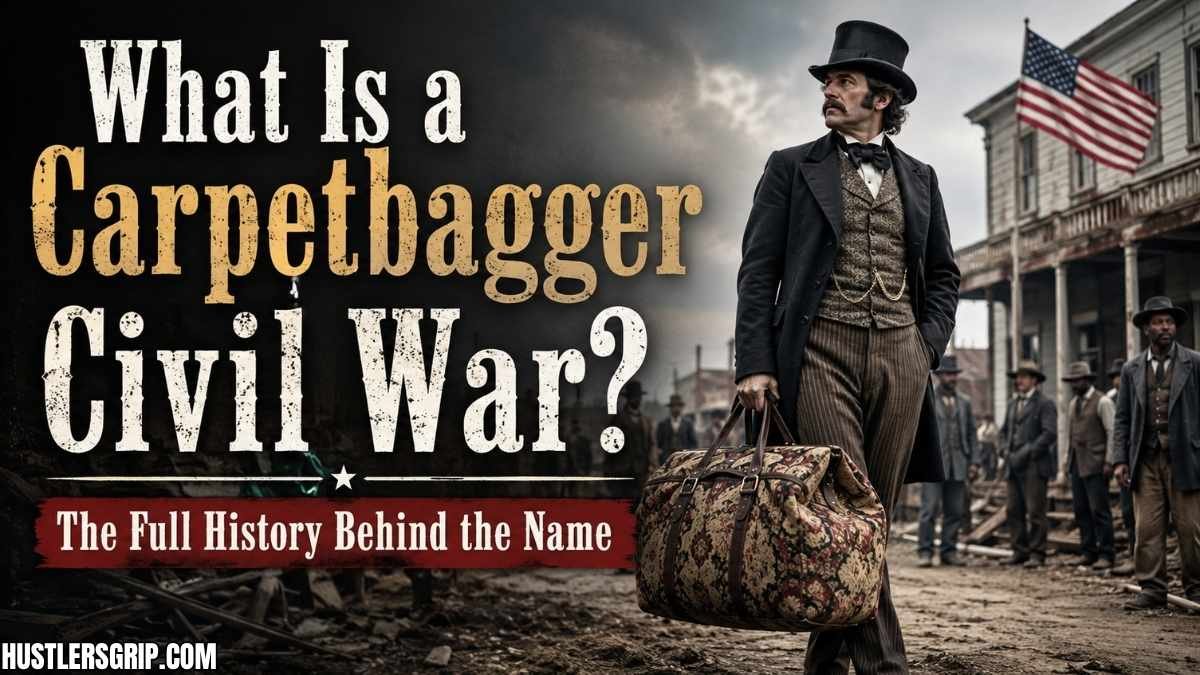
What Is a Carpetbagger Civil War? The Full History Behind the Name
Introduction about Carpetbagger Civil War
Have you ever heard someone called a “carpetbagger” and wondered what it really means? The word sounds strange, but it carries a heavy history from one of the most difficult times in American history. What is a carpetbagger civil war is a question many people ask when they first encounter this unusual term.
The answer takes us back to the years after the Civil War, during a period called Reconstruction. This was a time when the United States was trying to heal and rebuild after a terrible conflict. The term “carpetbagger” became a powerful label used by Southerners to describe Northerners who came south after the war. But the full story is much more interesting – and more complicated – than most people realize.
Featured Snippet: What Is a Carpetbagger?
A carpetbagger is a Northerner who moved to the Southern states after the American Civil War during the Reconstruction era (1865–1877). The term was meant as an insult. Southerners used it to describe Northerners they believed were coming south to take advantage of the region’s problems for their own gain. The name comes from the carpet bag – a cheap suitcase made from carpet fabric that many of these travelers carried. Today, the word still describes an outsider, especially a politician, who moves to a new place just to seek power or money.
Carpetbagger vs. Scalawag: Quick Comparison
| Feature | Carpetbagger | Scalawag |
|---|---|---|
| Who they were | Northerners who moved South | White Southerners |
| Where they came from | Northern states | Southern states |
| What they supported | Republican Party, Reconstruction | Republican Party, Reconstruction |
| How Southerners saw them | Unwelcome outsiders | Traitors to the South |
| Main motivation | Money, business, political power, or helping freed slaves | Personal gain or genuine belief in change |
| Famous examples | Union soldiers, teachers, businessmen | Small farmers, merchants |
Where Did the Term “Carpetbagger” Come From?
The word “carpetbagger” has a simple but meaningful origin. During the Civil War and the years that followed, many people traveled with carpet bags. These were inexpensive suitcases made from leftover carpet material.
A carpet bag was cheap, durable, and easy to carry. For many Northerners heading south after the war, this was their only luggage. They packed everything they owned into these bags and traveled to a region that was completely unfamiliar to them.
Southerners noticed these newcomers and their carpet bags. They started using the word “carpetbagger” as a way to mock them. The name suggested that these Northerners were so poor or so desperate that all their belongings fit into one cheap bag.
But the term was more than just a joke. It became a powerful insult. It meant that the person was an outsider who didn’t belong and who was only there to take advantage of the South’s suffering.
Expert Tip: The word “carpetbagger” first appeared in print around 1868. It quickly became one of the most hated labels in the South.
The Reconstruction Era: Setting the Stage
To understand what is a carpetbagger civil war, you need to know about Reconstruction. This was the period from 1865 to 1877 after the Civil War ended.
The South After the War
The Civil War left the South in ruins. Cities destroyed. Plantation burned. The economy had collapsed. Millions of enslaved people were now free, but they had no homes, no jobs, and no education.
White Southerners were angry and humiliated. They had lost the war. Their way of life gone. Many were bitter toward the North and everything it represented.
The Need for Change
The federal government had to figure out how to bring the Southern states back into the Union. This was a huge challenge. There were many questions:
- How would the former Confederate states rejoin the country?
- What rights would freed African Americans have?
- Who would lead the new Southern governments?
- How would the South rebuild its economy?
These questions led to the Reconstruction era, a time of great change and great conflict.
The Three Groups of Reconstruction
During Reconstruction, Southern Republican politics was made up of three main groups:
- Carpetbaggers – Northerners who came south
- Scalawags – White Southerners who supported Reconstruction
- Freedmen – African Americans who had been enslaved
These three groups worked together to create new state governments. They wrote new constitutions and built schools. They tried to create a more equal society.
But many white Southerners hated this coalition. They saw it as an attack on their way of life. And the carpetbaggers became the main targets of their anger.
Who Were the Carpetbaggers?
So who exactly these people called carpetbaggers? The truth is, they were a mixed group with different backgrounds and different reasons for coming south.
Not All Were the Same
Many people assume all carpetbaggers were greedy businessmen looking to make a quick buck. But historians say this picture is too simple.
The carpetbaggers included:
- Former Union soldiers who had fought in the war and stayed in the South afterward
- Teachers who came to educate newly freed African Americans
- Freedmen’s Bureau agents who worked for the government agency helping former slaves
- Businessmen who saw opportunities to invest in the struggling Southern economy
- Journalists and writers who came to report on the changes happening in the South
- Missionaries who wanted to help and serve communities in need
Where They Came From
Most carpetbaggers came from middle-class backgrounds in the Northern states. They were not the poorest people from the North. Many had decent educations and some money to invest.
They saw the South as a place of opportunity. Some wanted to help. Others wanted to make money. Many wanted both.
How Many Were There?
It is hard to know exactly how many carpetbaggers went south. But we do know that sixty carpetbaggers were elected to Congress during Reconstruction. Most Republican governors in the South during this time were from the North.
These numbers show that carpetbaggers had a real impact on Southern politics, even though they were not a huge percentage of the population.
What Did Carpetbaggers Actually Do in the South?
The activities of carpetbaggers varied widely. Some did good things. Some did bad things. Most did a mix of both.
Business and Economic Activities
Many carpetbaggers came south to make money. The South’s economy was in shambles, and there were opportunities for people with capital (money to invest).
Carpetbaggers:
- Bought land – Plantations were selling for very low prices
- Leased plantations – They rented large farms to grow cotton
- Started businesses – They opened stores, banks, and other enterprises
- Invested in railroads – The South needed better transportation
Some carpetbaggers became wealthy. But many lost money too. The Southern economy was unstable, and farming was risky.
Political Involvement
Politics was a major area where carpetbaggers made their mark.
After the war, many former Confederate leaders not allowed to hold public office. This created openings for new people to step in.
Carpetbaggers:
- Ran for office – They became state legislators, governors, and even U.S. representatives
- Helped write new state constitutions – These documents gave rights to African Americans
- Supported the Republican Party – They worked with African Americans and scalawags to build political power
- Fought for civil rights – Many supported laws that protected freed slaves
The carpetbaggers’ political involvement was controversial. Many Southerners saw it as outsiders meddling in their affairs.
Education and Social Reform
This is where carpetbaggers made some of their most lasting contributions.
Before the Civil War, the South had very few public schools. Most education private and enslaved people were not allowed to learn to read.
Carpetbaggers helped change this:
- They started schools for African American children
- They taught in Freedmen’s Bureau schools
- They helped found colleges for Black students
- They supported the creation of public school systems across the South
These educational efforts were extremely important. They gave millions of African Americans their first chance at formal education.
Carpetbaggers vs. Scalawags: What’s the Difference?
People often confuse carpetbaggers and scalawags. They are related but different.
| Carpetbagger | Scalawag | |
|---|---|---|
| Origin | From the North | From the South |
| Luggage | Carried a carpet bag | No special luggage |
| How Southerners saw them | Outsiders, invaders | Traitors, turncoats |
| Reasons for supporting Reconstruction | Often money or idealism | Often self-interest or Union loyalty |
The key difference is simple: carpetbaggers came from the North; scalawags were Southerners.
Scalawags were white Southerners who supported the Republican Party and Reconstruction. Many had been loyal to the Union during the war. Others saw supporting Reconstruction as a way to gain power or money.
Southerners hated scalawags even more than carpetbaggers in some ways. They saw them as traitors to their own region.
Both terms were insults. Both groups were targets of anger and sometimes violence.
Why Did Southerners Hate Carpetbaggers?
The hatred for carpetbaggers was intense and widespread. There were several reasons for this anger.
1. They Were Outsiders
Southerners had a strong sense of regional identity. They saw themselves as different from Northerners. When carpetbaggers came south, they were seen as intruders who didn’t understand Southern culture.
2. They Were Seen as Exploiters
Many Southerners believed carpetbaggers were only there to make money off their suffering. They saw carpetbaggers as vultures picking over the bones of a dead society.
3. They Supported African American Rights
Carpetbaggers worked with freed slaves and supported their right to vote and hold office. This enraged white Southerners who wanted to keep African Americans in a subordinate position.
4. They Changed the Political System
Carpetbaggers helped create new governments that included African Americans and excluded former Confederate leaders. This was a radical change that many Southerners could not accept.
5. They Were Blamed for Corruption
Some Reconstruction governments were corrupt. Carpetbaggers were often blamed for this corruption, even when it was no worse than corruption in other states.
The hatred was so strong that it led to violence. The Ku Klux Klan and other groups attacked carpetbaggers, scalawags, and African Americans who supported Reconstruction.
Were Carpetbaggers Good or Bad? A Balanced Look
This is one of the most important questions to ask when studying what is a carpetbagger civil war. The answer is not simple.
The Negative View
For many years, historians (especially Southern historians) painted carpetbaggers as villains. This view was popularized by the Dunning School of history, which portrayed Reconstruction as a terrible mistake.
According to this view, carpetbaggers were:
- Greedy – Only interested in making money
- Corrupt – Involved in scandals and stealing
- Manipulative – Using African Americans as tools for their own gain
- Ignorant – Not understanding Southern culture
This negative view was reinforced by movies like The Birth of a Nation, which showed carpetbaggers as evil figures destroying the South.
The Positive View
More recent historians have offered a different perspective. They argue that carpetbaggers were more complicated than the old stereotypes suggest.
According to this view, carpetbaggers:
- Helped build schools – Creating the South’s first public education systems
- Supported civil rights – Fighting for the rights of African Americans
- Brought needed investment – Helping to rebuild the Southern economy
- Were often idealistic – Many genuinely wanted to help
The Balanced Truth
The truth is probably somewhere in the middle.
Some carpetbaggers were greedy and corrupt. Some were idealistic reformers. Most were a mix of both – people who wanted to do good and also wanted to make a living.
Historian Richard Nelson Current, who wrote a famous book about carpetbaggers, argued that they were not as terrible as the old stories suggested. They were ordinary people caught up in extraordinary times.
Key Takeaway: The carpetbaggers were not all heroes or all villains. They were human beings with a mix of good and bad qualities, just like people in any group.
Famous Carpetbaggers in History
Several carpetbaggers became well-known figures during Reconstruction.
Albion Tourgée
Tourgée was a Union soldier who moved to North Carolina after the war. He became a judge and fought for the rights of African Americans. He later wrote novels about Reconstruction that showed the carpetbaggers’ perspective.
Adelbert Ames
Ames was a Union general who became governor of Mississippi. He tried to protect African American rights but faced fierce opposition. He eventually left the state when Reconstruction ended.
Henry Clay Warmoth
Warmoth was the governor of Louisiana during Reconstruction. He was one of the younger carpetbaggers, taking office at just 26 years old.
Marshall Twitchell
Twitchell was a Vermont native who became a powerful politician in Louisiana. He survived multiple assassination attempts and lived to tell his story.
These men were all different. Some were more idealistic. Others were more interested in power. But all of them played important roles in a critical period of American history.
How the Term “Carpetbagger” Is Used Today
The word “carpetbagger” didn’t disappear after Reconstruction ended. It is still used today, though the meaning has shifted somewhat.
Modern Political Usage
Today, “carpetbagger” is most often used in politics. It describes a politician who runs for office in a place where they have no real connection.
For example, if a person from New York moves to Texas and immediately runs for Congress, they might be called a carpetbagger. The term suggests that they are only interested in power, not in serving the community.
Business Usage
The term can also be used in business. A company that moves into a new area just to make money, without caring about the local community, might be called a carpetbagger.
The Meaning Has Softened
Today, the word is still negative, but it is not as harsh as it was during Reconstruction. It is more of a criticism than a deep insult.
Carpetbagger in Popular Culture
The term has appeared in books, movies, and TV shows over the years. The 1961 novel The Carpetbaggers (and the 1964 movie) used the term to describe a ruthless businessman.
Common Myths and Misunderstandings
There are many myths about carpetbaggers. Let’s clear up some of the most common ones.
Myth #1: All Carpetbaggers Were Poor
False. Most carpetbaggers came from middle-class backgrounds. They had enough money to travel and invest. They were not desperately poor.
Myth #2: All Carpetbaggers Were Corrupt
False. Some were corrupt, but many were honest. The corruption in Reconstruction governments was not worse than in other state governments at the time.
Myth #3: Carpetbaggers Only Cared About Money
False. Many carpetbaggers were teachers, missionaries, and reformers who wanted to help. They believed in the cause of racial equality and education.
Myth #4: There Were No Female Carpetbaggers
False. While most carpetbaggers were men, there were some women too. Carrie Highgate is one example of a female carpetbagger.
Myth #5: Carpetbaggers Were All White
False. While most carpetbaggers were white Northerners, some were African Americans who had escaped slavery, gone north, and then returned south to help.
Key Takeaways
Here are the most important things to remember about what is a carpetbagger civil war:
- Carpetbaggers were Northerners who moved to the South after the Civil War during Reconstruction (1865–1877)
- The name comes from the carpet bags they carried – cheap suitcases that suggested they were outsiders with no real roots in the South
- They were involved in politics, business, and education in the South. Some helped build schools and support civil rights. Others were more interested in making money
- Carpetbaggers worked alongside scalawags (white Southerners who supported Reconstruction) and freedmen (African Americans) to create new governments
- Southerners hated carpetbaggers, seeing them as outsiders who were exploiting the region’s suffering
- The reality is mixed – some carpetbaggers were corrupt, but many were honest people trying to help
- Today, the term is still used to describe outsiders in politics or business who seem to be acting only for their own benefit
Conclusion about Carpetbagger Civil War
So what is a carpetbagger civil war? The answer is more than just a simple definition. It is a story about a difficult time in American history – a time of rebuilding, conflict, and change.
The carpetbaggers were outsiders who came south after the Civil War. Some came for money. Some came to help. Many came for both reasons. They were hated by many Southerners, who saw them as invaders and exploiters. But they also made real contributions, especially in education and civil rights.
Understanding carpetbaggers helps us understand Reconstruction – one of the most important and misunderstood periods in American history. It reminds us that history is rarely simple. People are rarely all good or all bad. The carpetbaggers were complicated human beings, just like us.
Today, the word lives on as a reminder of that turbulent time. When we hear someone called a carpetbagger, we now know the history behind the name – a history of war, rebuilding, and the struggle to create a more equal society.
Want to learn more about American history? Check out our other articles on the Civil War, Reconstruction, and the fascinating people who shaped these events. Share this article with someone who loves history, or leave a comment below with your thoughts on the carpetbaggers and their legacy.
You May Also Like
- Fenaile Guide: Women’s Health, Empowerment & Wellness
- China SEO Xiaoyan: Best Practices for Organic Traffic
- SSIS 816: Revolutionizing Data Integration
External Resources
- Britannica: Carpetbagger Definition and History – A trusted encyclopedia entry with detailed information
- HISTORY.com: Carpetbaggers & Scalawags – A well-researched article from the History Channel
- Wikipedia: Carpetbagger – Comprehensive overview with historical context and references
Frequently Asked Questions About Carpetbagger Civil War
1. What is a carpetbagger in simple terms?
A carpetbagger is a person from the North who moved to the South after the Civil War. The term is usually negative and suggests the person came to take advantage of the situation.
2. Why were they called carpetbaggers?
They were called carpetbaggers because many carried their belongings in carpet bags – cheap suitcases made from carpet material. The name was meant to suggest they were poor and had no real connection to the South.
3. What did carpetbaggers do during Reconstruction?
Carpetbaggers did many things. Some started businesses, bought land, or invested in the Southern economy. Others went into politics, helping to create new state governments. Many worked as teachers, helping to educate newly freed African Americans.
4. How are carpetbaggers different from scalawags?
Carpetbaggers were Northerners who moved south. Scalawags were white Southerners who supported Reconstruction. Both groups supported the Republican Party, but they came from different places.
5. Was being a carpetbagger always a bad thing?
Not always. While the term was always meant as an insult, some carpetbaggers did good things. They built schools, supported civil rights, and helped rebuild the Southern economy. The reality is more complicated than the simple stereotype.
6. Is the term carpetbagger still used today?
Yes. Today, it is often used to describe a politician who runs for office in a place where they have no real connection. It can also describe a business that moves into a new area just to make money.
7. Did carpetbaggers help or hurt the South?
That depends on who you ask. They helped by bringing investment and building schools. They also helped protect the rights of African Americans. But they also angered many white Southerners and were involved in some corruption. The answer is not simple.
8. Were there carpetbaggers in other countries?
The term is mostly used in American history. However, similar ideas exist in other countries. Anywhere an outsider moves to a new place to seek power or money, people might use a similar label.


