
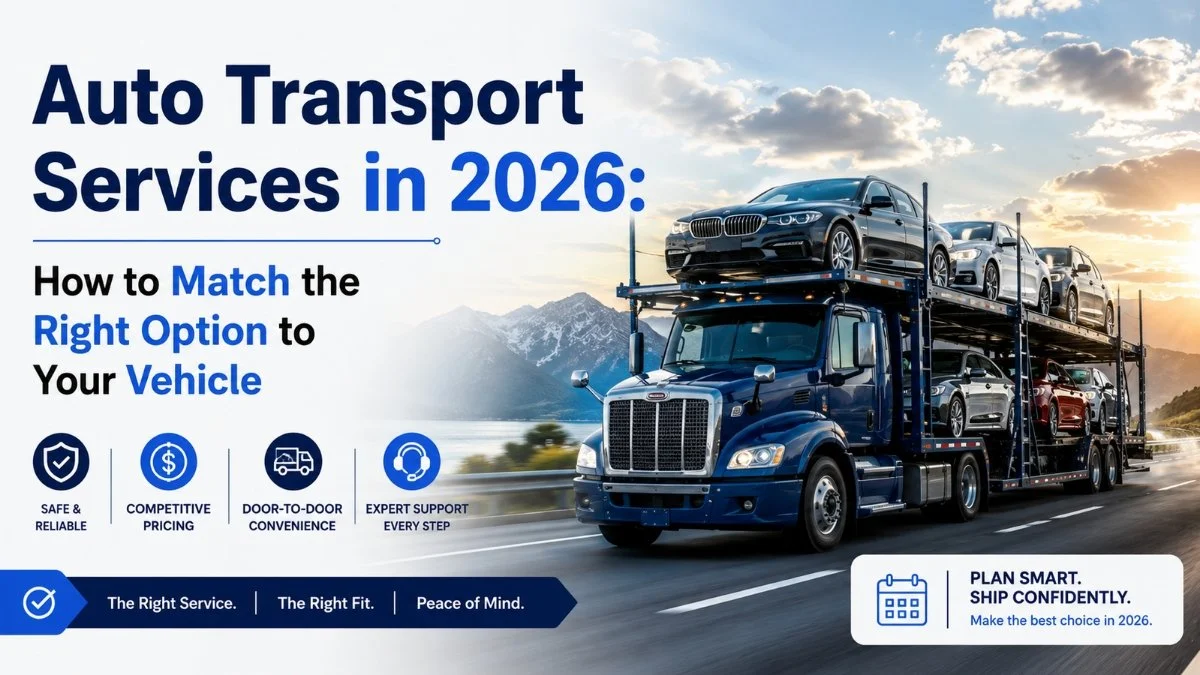
Auto Transport Services in 2026: How to Match the Right Option to Your Vehicle
Overview
Most car owners approach vehicle shipping backward. They chase the lowest quote first, then discover the service they booked does not fit their car, their street, or their timeline. A smarter sequence starts by understanding who is involved, which method suits the vehicle, and how price and timing are actually built. That is the order this guide follows.
Who you are actually hiring
The first thing to sort out is whether the company quoting you is a broker or a motor carrier, because the terms are not interchangeable. A motor carrier owns the trucks and physically hauls your vehicle. A broker arranges the shipment and assigns it to a vetted carrier from its network. Both are federally regulated, and both must be registered with the Federal Motor Carrier Safety Administration (FMCSA). Carriers operate under motor carrier authority with a USDOT number; brokers operate under broker authority.
You can verify any company yourself. FMCSA’s public SAFER system lets anyone search by company name, MC number, or USDOT number and see whether the entity holds broker authority, carrier authority, or both, and whether that authority is active. This matters more in 2026 than before: under 49 CFR Part 387, effective January 16, 2026, brokers and freight forwarders must maintain $75,000 in financial security through a BMC-84 surety bond or BMC-85 trust fund, and FMCSA will suspend operating authority if that security falls below the threshold and is not restored within seven business days of notice. For interstate auto haulers, FMCSA sets minimum public liability coverage that most carriers file at the $1,000,000 level. Confirming active authority and insurance is the single verification step most customers skip.
Choosing between open and enclosed transport
Open transport is the default for good reason. Vehicles ride on the same multi-car open trailers that deliver new cars to dealerships, and the method handles the large majority of shipments. RoadRunner Auto Transport’s 2026 data puts open carriers at 93 percent of shipments, averaging about $1,205, versus about $1,804 for enclosed. Your car is exposed to weather and road debris, but serious damage is uncommon, and availability and scheduling are far better. This is the sensible choice for everyday vehicles.
Enclosed transport puts your vehicle inside a covered trailer, shielded from weather, dust, and debris on all sides. It costs more because the trailers carry fewer vehicles (typically two to six), the equipment is specialized, and the carrier supply is smaller. FreightWaves Checkpoint reports enclosed typically runs 30 to 60 percent more than open. Enclosed carriers commonly offer hydraulic lift gates for low-clearance cars and soft-strap tie-downs that avoid the paint and undercarriage, though features vary between operators and are not universal, so confirm equipment when it matters. Enclosed makes sense for luxury, exotic, classic, antique, or freshly restored vehicles, not automatically for every shipment.
What door-to-door really involves
Door-to-door is the standard for most shipments, but the phrase oversells the geometry. A standard car carrier runs roughly 75 to 80 feet long. Narrow residential streets, low tree branches, tight turns, gated communities, apartment complexes, local truck restrictions, and dense urban blocks can all make it impossible to bring that rig to your exact address. In those cases the driver arranges a nearby safe and accessible meeting point, often a large retail parking lot. That is normal practice, not an upcharge or a bait-and-switch.
How quotes are built, and why
Quotes vary because the underlying costs vary. Distance is the biggest factor, but not in a straight line: per-mile rates fall as distance rises. FreightWaves Checkpoint’s 2026 tiers run about $1.25 to $2.00 per mile under 500 miles, $0.65 to $1.20 for 500 to 1,500 miles, and $0.55 to $0.95 above 1,500 miles, and it reports most people pay between $700 and $1,150. RoadRunner reports a 2026 national average of $1,215, at a median $1.23 per mile over a median 987 miles, with per-mile rates spanning $0.33 to $2.00. Treat these as market averages, not a promise for your specific shipment.
Beyond distance, several factors move the number. Larger, heavier vehicles take more deck space and add fuel weight (RoadRunner notes a pickup averages about $279 more than a sedan). Inoperable vehicles add roughly $150 to $300 because they need winch loading and a narrower pool of equipped carriers. Route popularity and carrier availability matter because busy interstate corridors fill trailers efficiently. Seasonality is real: summer peaks can run 10 to 30 percent above off-peak on the same lane. Fuel is a live input too; the U.S. Energy Information Administration reported the national on-highway diesel average at $5.652 per gallon for the week of August 24, 2026, up 19.8 cents on the week and its highest weekly reading since late May. Flexibility helps: a 3 to 5 day pickup window can trim cost by roughly 10 to 20 percent. Seeing how providers organize their vehicle shipping options helps you understand which variables you actually control.
Timing: windows and estimates, not promises
Separate the pieces. Booking comes first, then carrier assignment (commonly 24 to 72 hours), then the pickup window (often one to a few days from your first available date), then transit. Once loaded, transit typically runs 1 to 3 days under 500 miles, 3 to 5 days mid-range, and about 7 to 10 days coast to coast. These are estimates. Federal hours-of-service rules cap a driver at 11 hours of driving inside a 14-hour on-duty window, which is exactly why long hauls span several days. Guaranteed dates usually cost extra and should be in writing.
Preparing the vehicle and protecting yourself at handoff
An hour of prep prevents most disputes. Wash the car so existing damage is visible, photograph it from every angle, and remove personal items (many carriers allow a limited amount, often up to about 100 pounds in the trunk, but the interior should be clear). Leave about a quarter tank of fuel, check tires and battery, look for leaks, remove or secure accessories and roof racks, disable the alarm, and remove toll transponders. Have the keys ready.
The Bill of Lading is the document that protects you. At pickup, the driver records the vehicle’s condition; review it against your own photos before signing. At delivery, inspect again in good light and note any new damage on the document before you sign, because your signature confirms the condition at that point. If someone else receives the car, brief them, since a representative aged 18 or older can complete the inspection and paperwork.
Questions worth asking before booking
A short list prevents expensive surprises: Is this quote an estimate or fixed under specific conditions? Are you a broker or a carrier, and what is your MC or USDOT number? When is payment due, and is a deposit required before carrier assignment? What happens if my pickup date slips? How is the vehicle inspected, and what insurance should I review? What if the carrier cannot reach my street? Reputable companies answer plainly and put the important terms in writing. Reviews across several independent platforms add useful context, but they are a supplement to regulatory verification, not a replacement for it.


