
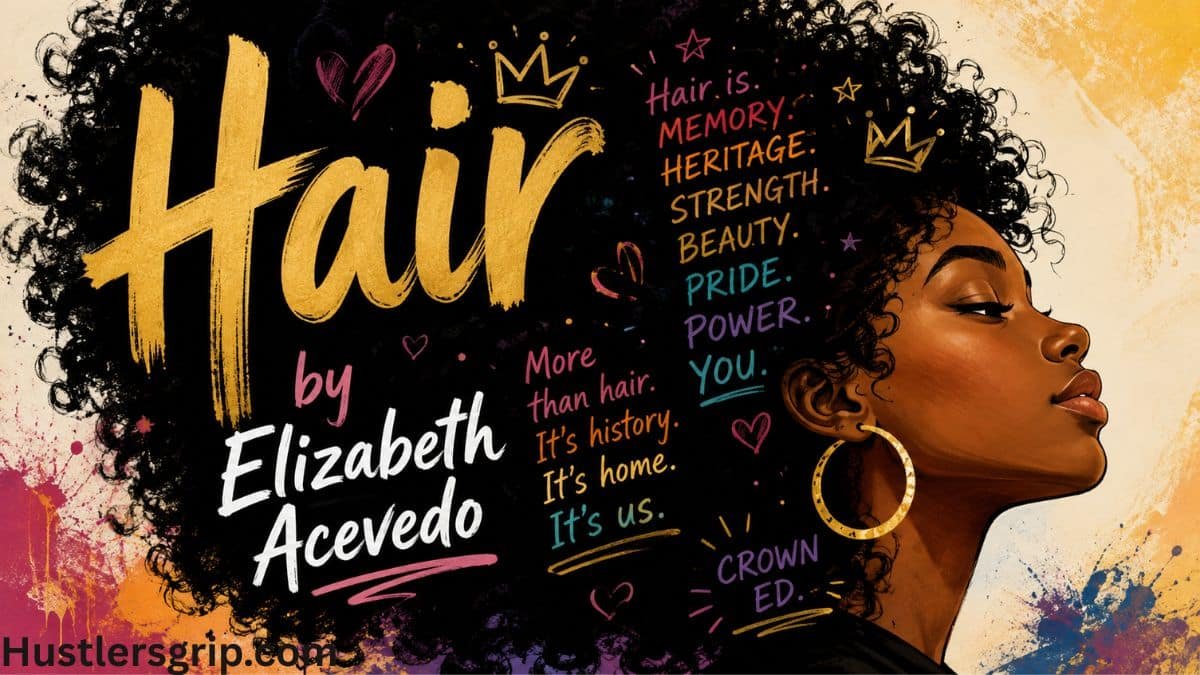
Hair by Elizabeth Acevedo: A Powerful Poem About Identity, Culture and Natural Beauty
Introduction
Have you ever been told to change something about yourself to fit in? For many people, hair is more than just hair. It tells a story about who they are and where they come from. Hair by Elizabeth Acevedo is a powerful spoken word poem that explores these deep feelings. It talks about identity, culture, and the pressure to look a certain way.
Elizabeth Acevedo is a Dominican-American poet and author. In her famous poem “Hair,” she shares a personal story about her mother telling her to “fix” her curly hair. But what does “fix” really mean? Through her words, Acevedo shows us how hair can be a symbol of heritage, pain, and pride. This article will explore the meaning behind hair by Elizabeth Acevedo and why it continues to inspire people around the world.
Featured Snippet Definition
What is “Hair” by Elizabeth Acevedo?
“Hair” is a spoken word poem by Dominican-American poet Elizabeth Acevedo. Written in 2009 for her thesis and performed in 2014, the poem explores the pressure on women of color to straighten their natural hair to fit white beauty standards. It uses hair as a symbol of cultural identity and resistance.
Key facts about the poem:
| Aspect | Details |
|---|---|
| Title | “Hair” |
| Author | Elizabeth Acevedo |
| Year Written | 2009 (for a thesis) |
| Year Performed | 2014 (went viral) |
| Format | Spoken word poem |
| Themes | Identity, culture, beauty standards, generational trauma |
| Adaptation | Became part of the visual book “Inheritance” (2022) |
Who Is Elizabeth Acevedo?
Elizabeth Acevedo is a Dominican-American poet, author, and performer. She was born and raised in New York City. Her parents came from the Dominican Republic, and her cultural background shapes much of her writing.
Acevedo is not just a poet. She is also a bestselling author. Her novel The Poet X won the National Book Award for Young People’s Literature. She has also written With the Fire on High and Clap When You Land. In 2022, the Poetry Foundation named her the Young People’s Poet Laureate.
Before becoming a famous writer, Acevedo was a teacher. She also competed in poetry slams and became a National Poetry Slam Champion. Her spoken word performances known for their emotional power and raw honesty.
Key facts about Elizabeth Acevedo:
- Born: 1988
- Birthplace: Harlem, New York City
- Education: BA in Performing Arts from George Washington University; MFA in Creative Writing from the University of Maryland
- Notable Works: The Poet X, With the Fire on High, Clap When You Land, Inheritance
- Awards: National Book Award, Pura Belpré Award, Carnegie Medal, Printz Award
Acevedo’s work often explores themes of identity, culture, and the experiences of Afro-Latinas. Her poem hair by Elizabeth Acevedo is one of her most famous and powerful pieces.
The Story Behind “Hair”
Every great poem has a story behind it. Hair by Elizabeth Acevedo is no different. Acevedo wrote the poem in 2009 as part of her thesis. She was only 20 years old at the time.
The poem came from a real-life experience. Acevedo’s mother once told her to “fix” her hair. By “fix,” her mother meant straighten it. This comment hurt Acevedo deeply. It made her feel like her natural hair was not good enough.
But Acevedo did not stay silent. She turned her pain into poetry and wrote about the pressure to change her hair to fit white beauty standards. She also wrote about the history behind that pressure.
Timeline of the poem:
- 2009: Written for a thesis at the University of Maryland
- 2014: Performed as a spoken word piece and went viral
- 2022: Adapted into the visual book Inheritance: A Visual Poem with illustrations by Andrea Pippins
The poem resonated with many people. It spoke to the experiences of women of color who had told to change their natural hair. It also started important conversations about beauty standards and cultural identity.
What Is the Poem “Hair” About?
Hair by Elizabeth Acevedo is about a young woman’s struggle with her natural hair. The poem begins with the lines:
“My mother tells me to fix my hair. And by ‘fix,’ she means straighten. She means whiten.”
These opening lines set the tone for the entire poem. The speaker’s mother wants her to change her hair to look more “acceptable.” But the speaker questions this. She asks:
“But how do you fix this ship-wrecked history of hair?”
This question is powerful. It shows that hair is not just about looks. It carries history, pain, and meaning.
Throughout the poem, Acevedo uses hair as a symbol. Curly hair represents her culture and her ancestors. Straightening it would mean erasing that history. She writes:
“You call them wild curls. I call them breathing. Ancestors spiraling.”
For Acevedo, her curls are alive. They connect her to her ancestors. They are not something to be “fixed.”
The poem also talks about the history of colonialism. It shows how beauty standards used to control and erase Black and Brown bodies. Acevedo writes about:
“Trying to find ways to erase them out of our skin, iron them out of our hair.”
This line refers to the painful history of forced assimilation. For centuries, people of color were told that their natural features were ugly or unprofessional. They were pressured to change their hair, skin, and even their language.
What does the poem say about beauty?
- Natural hair is beautiful and should be celebrated
- Beauty standards are often based on racism and colonialism
- Changing your hair to fit in means erasing your identity
- True beauty comes from accepting who you are
The poem ends with a message of hope and resistance. Acevedo writes about embracing her curls and teaching her children to do the same. She writes:
“Our bodies curve into one another like an echo, and I let my curtain of curls blanket us from the world, how our children will be beautiful.”
This ending is powerful. It shows that the speaker will not give in to pressure. She will teach her children to love their natural hair and their heritage.
Themes in “Hair” by Elizabeth Acevedo
Hair by Elizabeth Acevedo is rich with themes. Let’s explore the most important ones.
Identity and Self-Acceptance
The poem is about finding and accepting your identity. The speaker struggles with her hair because society tells her it is not acceptable. But she learns to embrace it.
Key message: Your identity is not something to be “fixed.” It is something to be celebrated.
Acevedo shows that hair is a big part of identity. For many people of color, hair is connected to culture, family, and history. Changing it means losing a part of yourself.
Generational Trauma
The poem also explores generational trauma. This means pain and struggles that are passed down from one generation to the next.
Acevedo’s mother tells her to straighten her hair. But where did this idea come from? It came from generations of pressure to fit white beauty standards. Acevedo writes about this history:
“The poem tackles generational trauma and posits the powerful question, ‘Did our ancestors imagine that their great-grandchildren would look like us?'”
This question is heartbreaking. It shows that the pressure to change is not new. It has been passed down for generations.
Beauty Standards and Colonialism
Another major theme is the link between beauty standards and colonialism. Colonialism is when one country takes control of another. It often involves forcing the colonized people to adopt the colonizer’s culture.
In the poem, Acevedo shows how colonialism affected beauty standards. People of color were told that their natural features were ugly. They were pressured to look more like white people.
Examples from the poem:
- “She means straighten. She means whiten.”
- “Trying to find ways to erase them out of our skin, iron them out of our hair”
- “This ship-wrecked history of hair”
These lines show how beauty standards are not neutral. They are rooted in racism and oppression.
Resistance and Pride
Despite all the pain, the poem is also about resistance. The speaker refuses to straighten her hair. She embraces her curls and her heritage.
How does the speaker resist?
- She calls her curls “breathing” instead of “wild”
- She connects her hair to her ancestors
- She imagines a future where her children will be beautiful with their natural hair
This resistance is powerful. It shows that you can break the cycle of generational trauma. You can choose to love yourself and your heritage.
Analysis of Key Lines
Let’s look at some of the most important lines from hair by Elizabeth Acevedo. We will break down what they mean.
Line 1: “My mother tells me to fix my hair.”
This line sets up the conflict. The speaker’s mother wants her to change her hair. But the word “fix” is loaded. It implies that something is broken.
What does “fix” really mean? In this context, it means straighten. It means make it look more like white hair. It means erase the curls that connect the speaker to her culture.
Line 2: “And by ‘fix,’ she means straighten. She means whiten.”
This line makes the meaning clear. The mother is not just talking about hair. She is talking about race. She wants her daughter to look whiter.
This is a painful moment. The speaker realizes that her mother sees her natural hair as a problem. She also realizes that this idea comes from a history of racism.
Line 3: “But how do you fix this ship-wrecked history of hair?”
This line is the heart of the poem. The speaker questions the idea of “fixing” her hair. She asks how you can fix something that carries so much history.
The word “ship-wrecked” is powerful. It suggests that history is chaotic and broken. It also suggests that the speaker is trying to navigate through it.
Line 4: “You call them wild curls. I call them breathing.”
This line is a turning point. The speaker reclaims her curls. She rejects the label “wild.” Instead, she calls them “breathing.”
What does “breathing” mean? It means alive. It means connected to life and ancestors. It means not something to be tamed or fixed.
Line 5: “Ancestors spiraling.”
This line connects the speaker’s hair to her ancestors. The curls are not just hair. They are the spirits of those who came before.
This is a beautiful image. It shows that the speaker’s identity is rooted in her heritage. Her hair is a living connection to her past.
Line 6: “Trying to find ways to erase them out of our skin, iron them out of our hair.”
This line refers to the history of forced assimilation. People of color were pressured to erase their features. They were told to straighten their hair and lighten their skin.
The word “iron” is also a double meaning. It refers to both the iron used to straighten hair and the iron of oppression. It shows how beauty standards are a form of control.
Line 7: “Our bodies curve into one another like an echo, and I let my curtain of curls blanket us from the world, how our children will be beautiful.”
This is the ending of the poem. It is a moment of hope and defiance. The speaker embraces her curls and her partner. She imagines a future where her children will be beautiful.
The word “curtain” suggests protection. The speaker’s curls shield her and her partner from the world’s judgment. They create a safe space.
The final line, “how our children will be beautiful,” is a promise. The speaker will teach her children to love themselves. She will break the cycle of shame.
The Spoken Word Performance
One of the reasons hair by Elizabeth Acevedo is so powerful is because of how it is performed. Acevedo is a spoken word artist. She delivers her poems with emotion, rhythm, and physical expression.
What is spoken word? Spoken word is a type of poetry that is meant to be performed out loud. It often includes elements of theater, music, and storytelling.
Acevedo’s performance of “Hair” is famous. She performs it with dramatic hand gestures and a powerful voice. The performance creates a sense of urgency and tension. You can feel the speaker’s pain and anger.
What makes the performance so effective?
- Emotion: Acevedo’s voice conveys deep feeling. You can hear the hurt in her words.
- Rhythm: The poem has a musical quality. The words flow like a song.
- Physicality: Acevedo uses her body to express the poem. She gestures to her hair and her heart.
- Connection: She makes eye contact with the audience. She invites them into her experience.
The performance went viral in 2014. People all over the world watched it and shared it. It started conversations about hair, identity, and beauty standards.
Where can you watch it? The performance is available on YouTube. It is a must-watch for anyone who wants to understand the poem.
Why “Hair” Matters Today
Hair by Elizabeth Acevedo was written over a decade ago. But it is still relevant today. Why?
The Natural Hair Movement
The natural hair movement has grown in recent years. More and more people of color are embracing their natural hair. They are rejecting chemical straighteners and heat damage.
Acevedo’s poem is a part of this movement. It gives voice to the struggles and joys of natural hair. It encourages people to love their curls, coils, and waves.
Conversations About Beauty Standards
Beauty standards are still a big issue. Many people feel pressure to look a certain way. This pressure is often based on race and gender.
Hair by Elizabeth Acevedo helps us question these standards. It shows that beauty is not one-size-fits-all. It encourages us to celebrate diversity.
Representation Matters
Representation is important. When people see themselves in art and media, it validates their experiences.
Acevedo’s poem gives representation to Afro-Latinas and people of color. It shows that their stories matter. It also shows that they are not alone in their struggles.
The Power of Poetry
Finally, the poem reminds us of the power of poetry. Poetry can heal, inspire, and create change. It can give voice to the voiceless.
Hair by Elizabeth Acevedo is a perfect example. It started as a personal story. But it became a movement. It touched millions of people around the world.
Common Questions About the Poem
Here are some common questions people ask about hair by Elizabeth Acevedo.
What is the mood of “Hair” by Elizabeth Acevedo?
The mood is reflective and intimate. The poem feels personal and emotional. It makes you think about your own experiences with identity and beauty.
What is the tone of “Hair” by Elizabeth Acevedo?
The tone is sentimental with elements of nostalgia. The speaker looks back on her experiences with pain but also with love.
What does hair symbolize in the poem?
Hair symbolizes culture, identity, and history. It represents the speaker’s connection to her ancestors. It also represents the pressure to assimilate.
Why did Elizabeth Acevedo write “Hair”?
Acevedo wrote the poem in response to her mother telling her to “fix” her hair. She wanted to explore the pain and history behind that comment.
What is the main message of “Hair”?
The main message is that you should embrace your identity. Your natural hair is beautiful. You do not need to change it to fit in.
Related Articles You May Like
- Does Leadingecuador.com Have a Blog?
- Poversatt: What You Need to Know
- Offertstop.eu: A Complete Guide
- Makeiva Albritten Age: Everything You Need to Know
Conclusion
Hair by Elizabeth Acevedo is more than just a poem. It is a powerful statement about identity, culture, and self-acceptance. Through her words, Acevedo shows us that hair is not just hair. It is a symbol of who we are and where we come from.
The poem challenges us to question beauty standards. It encourages us to embrace our natural features. It reminds us that our heritage is something to be proud of, not something to be erased.
Whether you are a person of color struggling with your hair or someone who wants to understand these experiences better, this poem has something to offer. It is a testament to the power of poetry and the resilience of the human spirit.
Ready to explore more inspiring content? Check out our related articles above. And don’t forget to watch Elizabeth Acevedo’s powerful performance of “Hair” on YouTube. Let her words inspire you to embrace your own unique beauty.
Frequently Asked Questions (FAQs)
1. What is “Hair” by Elizabeth Acevedo about?
“Hair” is a spoken word poem about the pressure on women of color to straighten their natural hair. It explores themes of identity, culture, and beauty standards. The poem challenges the idea that natural hair needs to be “fixed.”
2. When was “Hair” by Elizabeth Acevedo written?
The poem was written in 2009 as part of Acevedo’s thesis at the University of Maryland. It was later performed as a spoken word piece in 2014.
3. What is the poem “Hair” by Elizabeth Acevedo about?
The poem is about a young woman whose mother tells her to “fix” her hair. The speaker questions what “fix” really means. She realizes that her mother wants her to straighten her hair to fit white beauty standards. The poem explores the pain and history behind this pressure.
4. What does the poem “Hair” symbolize?
Hair symbolizes culture, identity, and history. It represents the speaker’s connection to her ancestors. It also represents the pressure to assimilate and erase one’s heritage.
5. What are the themes in “Hair” by Elizabeth Acevedo?
The main themes are identity, self-acceptance, generational trauma, beauty standards, colonialism, resistance, and pride.
6. Is “Hair” by Elizabeth Acevedo a book?
Yes, the poem was adapted into a visual book called Inheritance: A Visual Poem. It was published in 2022 with illustrations by Andrea Pippins.
7. Where can I read “Hair” by Elizabeth Acevedo?
You can find the poem text on various websites. The full text is also available in the book Inheritance: A Visual Poem. You can also watch Acevedo perform the poem on YouTube.
8. What is Elizabeth Acevedo famous for?
Elizabeth Acevedo is famous for her spoken word poetry and her novels. Her debut novel The Poet X won the National Book Award for Young People’s Literature. She is also the Young People’s Poet Laureate.
9. What is the meaning of “Hair” by Elizabeth Acevedo?
The meaning is that natural hair is beautiful and should be celebrated. The poem challenges the idea that people of color need to change their hair to fit in. It encourages self-acceptance and pride in one’s heritage.
10. What is the poem “Hair” by Elizabeth Acevedo called?
The poem is simply called “Hair.” It is sometimes referred to as “Hair by Elizabeth Acevedo” to distinguish it from other poems with the same title.


