
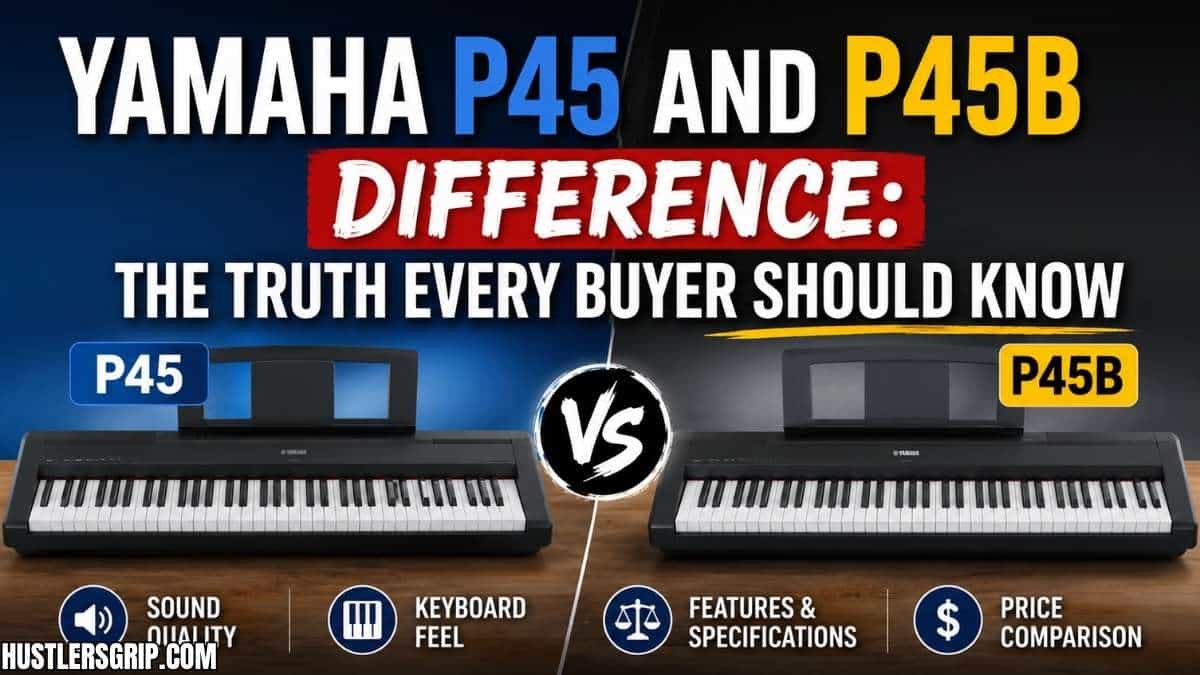
Yamaha P45 and P45B Difference: The Truth Every Buyer Should Know
Introduction
If you are shopping for a digital piano, you have probably seen two nearly identical model names: Yamaha P45 and Yamaha P45B. At first glance, many buyers assume that the P45B is a newer version, an upgraded edition, or a special premium model. This confusion has led thousands of musicians, beginners, and parents to spend hours comparing specifications online.
The good news is that the Yamaha P45 and P45B difference is much simpler than most people think. Before spending your money, it is important to understand exactly what separates these models and whether one offers any advantages over the other. This guide explains everything in simple language so you can make the right buying decision with confidence.
Featured Snippet: Yamaha P45 and P45B Difference
The Yamaha P45 and P45B difference is mainly in the model naming. The letter “B” stands for Black, indicating the piano’s color finish. Both models have the same keyboard action, sound engine, speakers, connectivity options, and performance features. There is no functional or technical difference between them.
| Feature | Yamaha P45 | Yamaha P45B |
|---|---|---|
| Keys | 88 | 88 |
| Action | GHS Weighted | GHS Weighted |
| Sound Engine | AWM Stereo Sampling | AWM Stereo Sampling |
| Polyphony | 64 Notes | 64 Notes |
| Color | Black | Black (B = Black) |
| Performance | Same | Same |
Introduction to Yamaha P45 Series
The Yamaha P45 has become one of the most popular entry-level digital pianos in the world. Many music teachers recommend it because it provides a realistic piano-playing experience without the high cost of an acoustic piano. Yamaha designed this model for students, hobbyists, and home musicians who want authentic touch and sound.
One reason for its popularity is the balance between affordability and quality. Instead of filling the instrument with unnecessary features, Yamaha focused on creating a solid piano experience. This approach has made the P45 a favorite choice for beginners and intermediate players alike.
Why Buyers Get Confused
The confusion usually starts when shoppers notice listings for both the P45 and the P45B. Some retailers use the names interchangeably, while others only display one version. This creates the impression that there are two separate products.
Online discussions, review websites, and customer forums frequently ask the same question: “What is the difference between Yamaha P45 and P45B?” The answer is surprisingly simple and has been confirmed by multiple sources and Yamaha product listings.
What Does the “B” Mean?
The letter B in P45B stands for Black. It is simply a color designation used by Yamaha and retailers. The piano itself remains identical to the standard P45.
Think of it like buying a smartphone. Some stores may list a phone as “Black Edition” while others simply use the base model name. The device remains the same. The same principle applies here.
Understanding Yamaha Naming Conventions
Manufacturers often add letters to model numbers to indicate finishes, colors, or regional variations. In Yamaha’s case, the “B” is commonly used to indicate black-colored instruments.
Since the Yamaha P45 is already sold primarily in black, many customers find the additional letter confusing. Yet it does not signal any upgrade in sound, technology, or hardware.
Yamaha P45 vs P45B Quick Comparison
Many buyers appreciate a simple side-by-side comparison before diving into technical details.
| Specification | Yamaha P45 | Yamaha P45B |
| Number of Keys | 88 | 88 |
| Key Action | GHS | GHS |
| Polyphony | 64 Notes | 64 Notes |
| Voices | 10 | 10 |
| Speakers | Same | Same |
| Weight | 11.5 kg | 11.5 kg |
| Connectivity | USB to Host | USB to Host |
| Color | Black | Black |
| Performance | Identical | Identical |
The table clearly shows there is no measurable performance difference between the two models.
Keyboard Action Comparison
One of the strongest features of the Yamaha P45 series is its Graded Hammer Standard (GHS) keyboard action. Yamaha designed this system to mimic the feel of an acoustic piano. Lower notes feel heavier, while higher notes feel lighter.
For beginners, this is a major advantage. Learning on weighted keys helps build finger strength and proper playing technique. Students who eventually transition to acoustic pianos will feel much more comfortable because the touch response is similar.
GHS Key Technology
The GHS action remains identical on both models. There is no special upgrade or modification on the P45B version.
Players can expect:
- Realistic piano touch
- Responsive key action
- Improved finger control
- Better learning experience
These features make both models excellent choices for piano education.
Sound Quality Comparison
Sound quality is another area where buyers often expect differences. However, Yamaha uses the same sound engine in both instruments.
The P45 series utilizes AWM Stereo Sampling, a technology that captures recordings of real acoustic pianos and reproduces them digitally. This creates a rich and natural piano tone suitable for practice, lessons, and home performances.
AWM Stereo Sampling
The sound engine delivers:
- Authentic grand piano tone
- Natural sustain characteristics
- Dynamic volume response
- Consistent sound quality
Whether you purchase a P45 or P45B, your ears will hear exactly the same performance.
Design and Build Quality
The Yamaha P45 is known for its slim design and practical construction. With a depth of less than 30 cm and a weight of approximately 11.5 kg, it is easy to move and store.
This portability makes it a great choice for:
- Small apartments
- Dorm rooms
- Home studios
- Music classrooms
Portability Features
Many musicians appreciate being able to transport the piano without difficulty. The lightweight frame allows players to set up quickly for lessons or small performances.
Since the external design remains unchanged, both versions provide identical portability benefits.
Connectivity and Functions
Modern digital pianos need practical connectivity options, and Yamaha includes essential features in the P45 series.
Users can connect the piano to computers, music software, and educational applications through USB connectivity. A sustain pedal is also included, helping create a more authentic playing experience.
USB and Pedal Support
Important connectivity features include:
- USB to Host connection
- Headphone output
- Sustain pedal support
- Power-saving functions
Every feature available on the P45 is also available on the P45B. There are no hidden extras in either version.
Performance for Beginners
The Yamaha P45 has earned a strong reputation among piano teachers. It offers enough realism to support proper learning while remaining affordable for families.
Many beginners struggle when using unweighted keyboards because the playing experience differs significantly from a real piano. The P45 solves this issue with weighted keys and authentic touch response.
Learning Advantages
Benefits for new players include:
- Improved finger strength
- Better technique development
- Realistic piano feel
- Long-term learning value
These advantages exist equally on both the P45 and P45B models.
Performance for Intermediate Players
Intermediate musicians often wonder if the P45 remains useful after the beginner stage. The answer is yes. While advanced performers may eventually seek premium features, many intermediate players continue using the P45 for years.
The realistic keyboard action and dependable sound make it suitable for daily practice, lessons, and casual performances.
Practice Benefits
Intermediate players enjoy:
- Consistent key response
- Reliable sound quality
- Portable design
- Easy maintenance
Because the P45B is technically identical, performance remains exactly the same.
Buying Advice: Which Model Should You Choose?
The best advice is simple: choose whichever model offers the best price and availability.
Since there is no hardware difference, your decision should focus on:
- Price
- Warranty
- Retailer reputation
- Included accessories
If a store lists a P45B at a lower price than a P45, buy the P45B. If the opposite is true, choose the P45. Either way, you receive the same digital piano.
Helpful Resources
Suggested Internal Links
- Read our guide on digital piano buying tips
- Explore our beginner keyboard learning resources
Authority External Resources
- Yamaha Official P45 Specifications
- Yamaha Product Overview Page
Conclusion
The truth about the Yamaha P45 and P45B difference is refreshingly simple. Despite the confusion created by model naming, there is no technical, functional, or performance difference between these two digital pianos. The letter B merely represents the black finish designation used by Yamaha and some retailers.
If you are choosing between the two, focus on pricing, warranty coverage, and included accessories rather than the model name. Both instruments deliver the same authentic Yamaha playing experience, making them excellent choices for beginners and intermediate players. For more helpful music and technology guides, check out this useful resource on digital trends and insights: Unbannedg+
Frequently Asked Questions
1. Is Yamaha P45B newer than Yamaha P45?
No. The P45B is not a newer model. The “B” simply refers to the black finish designation.
2. Do Yamaha P45 and P45B sound different?
No. Both use the same AWM Stereo Sampling sound engine and produce identical sound quality.
3. Is the keyboard action different on the P45B?
No. Both models feature Yamaha’s Graded Hammer Standard (GHS) weighted keyboard action.
4. Which model is better for beginners?
Both are equally suitable because they are the same instrument with identical features.
5. Why do some stores use P45 while others use P45B?
Retailers often use different naming conventions. Some include the color designation while others use the standard model name.
6. Should I pay extra for the Yamaha P45B?
No. Since there is no feature difference, paying extra is generally unnecessary unless additional accessories are included.


